
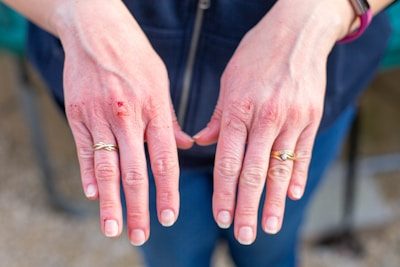
Evidence-based treatment
The framework is a treatment ladder, and every level continues the one beneath it. Emollients never stop.
| Step | Treatment | Indication |
| Foundation | Emollients, bathing practice, trigger avoidance | Everyone, always |
| Step 1 | Topical corticosteroids; topical calcineurin inhibitors | Mild-to-moderate; flare treatment |
| Step 2 | Proactive maintenance twice weekly; non-steroidal topicals (PDE4 inhibitors, topical JAK, tapinarof) | Recurrent flares at the same sites |
| Step 3 | Narrowband UVB phototherapy | Moderate disease inadequately controlled by topicals; useful steroid-sparing option |
| Step 4 | Conventional systemics: ciclosporin, methotrexate, azathioprine, mycophenolate | Moderate-to-severe |
| Step 5 | Biologics; oral JAK inhibitors | Moderate-to-severe inadequately controlled by the above |

Step 5: Biologics and oral JAK inhibitors
This is where atopic dermatitis treatment has changed beyond recognition. These advances represent the most significant treatment breakthroughs in dermatology in over a decade.。
Biologics are injected antibodies that block a single inflammatory signal. They are not general immunosuppressants, and they do not require routine blood monitoring.
Europe, the approved biologics are dupilumab (anti-IL-4Rα, 2017), tralokinumab (anti-IL-13, 2021), lebrikizumab (anti-IL-13, 2023) and nemolizumab (anti-IL-31Rα, 2024), alongside the JAK inhibitor baricitinib (2020).
| Agent | Target | Approved ages (US) | Notes |
| Dupilumab | IL-4/IL-13 | 6 months and older | Longest track record; the reference standard |
| Tralokinumab | IL-13 | 12 years and older | IL-13 selective |
| Lebrikizumab | IL-13 | 12 years and older, ≥40 kg | An alternative for those who do not tolerate dupilumab or prefer monthly dosing |
| Nemolizumab | IL-31 receptor α | 12 years and older | Particularly for patients prioritising relief from itch |
On durability, which is what patients actually want to know: long-term data showed more than 83% of patients receiving lebrikizumab every 2–4 weeks maintained a sustained clinical response after 3 years.
Nemolizumab is the newest mechanism and works differently from the rest. Approved in December 2024 for moderate-to-severe AD in combination with topical corticosteroids and/or calcineurin inhibitors in patients aged 12 and older, it was the first FDA-approved monoclonal antibody exclusively targeting IL-31 receptor alpha. It addresses the itch pathway specifically, in contrast to dupilumab which blocks both IL-4 and IL-13 signalling to reduce inflammation. In the pivotal trials, 44% and 42% of nemolizumab patients achieved EASI-75 compared with 29% and 30% on placebo, with itch improving as early as the first week and sleep disturbance improving by week 16.
Oral JAK inhibitors are tablets that block several inflammatory signals at once inside the cell. This class has demonstrated high efficacy in phase 3 trials, often showing rapid itch reduction and significant skin clearance compared with placebo. Abrocitinib and upadacitinib have both shown superior efficacy results to dupilumab in clinical studies. Upadacitinib and abrocitinib are the only oral JAK inhibitors approved in the United States for patients 12 years and older, while baricitinib is approved for AD in Europe and Japan.
They act faster than biologics — itch often improves within days — and are taken by mouth rather than injected. The trade-off is that they require regular blood monitoring and carry class warnings relating to infection including herpes zoster, blood count and lipid changes, and cardiovascular and thrombotic risk in older patients with risk factors. For a young, otherwise healthy patient with severe disease, the balance is often favourable; in an older patient with cardiovascular risk factors, a biologic is usually preferred. This is a decision to make jointly, with the numbers laid out.
How quickly do these work? Newer treatments typically provide itch relief within 24–48 hours, with visible skin improvement over 1–2 weeks — considerably faster than topical steroids, which may take 1–2 weeks for itch relief and 2–4 weeks for substantial improvement.
On access and cost. Coverage for approved JAK inhibitors and biologics in moderate-to-severe AD typically follows documented inadequate response to conventional treatment, with prior authorisation commonly requiring documentation of failed treatment over 8–12 weeks. Hong Kong insurance arrangements differ from those described in international sources, and registration status here should be confirmed for each agent individually. Documented severity scores from the outset make any subsequent application considerably easier — another reason to score and photograph at the first visit.
Reference:
- Davis DMR, Drucker AM, Alikhan A, et al. AAD guidelines of care for the management of atopic dermatitis in adults with topical therapies. J Am Acad Dermatol. 2023.
- Sidbury R, Alikhan A, Bercovitch L, et al. AAD guidelines of care for the management of atopic dermatitis in adults with phototherapy and systemic therapies. J Am Acad Dermatol. 2023.
- Guidelines Development Panel of the Hong Kong College of Paediatricians. Management of Atopic Dermatitis in Children: 2020 Review. HK J Paediatr. 2021;26:42-57. — the key local reference; cite this prominently.
- Wollenberg A, Kinberger M, Arents B, et al. EuroGuiDerm guideline on atopic eczema. J Eur Acad Dermatol Venereol. (most recent update).
- National Institute for Health and Care Excellence. Atopic eczema in under 12s: diagnosis and management. CG57.
- Leung R, Wong G, Lau J, et al. Prevalence of asthma and allergy in Hong Kong schoolchildren: an ISAAC study. Eur Respir J 1997.
- Childhood Wheeze, Allergic Rhinitis, and Eczema in Hong Kong: ISAAC Study from 1995 to 2015. — source of the 21-year local trend data.
- Severity scoring of atopic dermatitis: the SCORAD index. Consensus Report of the European Task Force on Atopic Dermatitis. Dermatology 1993;186:23-31.
- Efficacy and Safety of Lebrikizumab in Combination With Topical Corticosteroids in Adolescents and Adults With Moderate-to-Severe Atopic Dermatitis: A Randomized Clinical Trial (ADhere). JAMA Dermatol.
- ARCADIA 1 and ARCADIA 2 — two identically designed pivotal phase III trials enrolling more than 1,700 patients, evaluating nemolizumab administered subcutaneously every four weeks versus placebo with background topical corticosteroids.
- Sanofi. Press release: decision not to submit amlitelimab in atopic dermatitis for global regulatory reviews. Paris, 24 July 2026.
- Simpson EL, Bieber T, Guttman-Yassky E, et al. Two Phase 3 Trials of Dupilumab versus Placebo in Atopic Dermatitis (SOLO 1 and SOLO 2). N Engl J Med. 2016.
- Chalmers JR, et al. BEEP trial: daily emollient during the first year of life for preventing atopic dermatitis. Lancet. 2020. — the negative prevention trial cited in the article.
- Hong Kong Drug Office, Department of Health — verify local registration status of every systemic agent named.

