
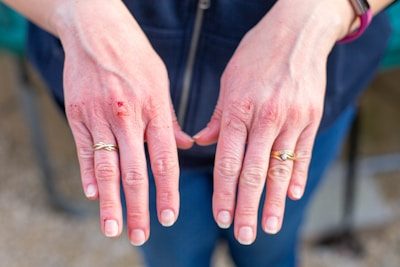
Evidence-based treatment
The framework is a treatment ladder, and every level continues the one beneath it. Emollients never stop.
| Step | Treatment | Indication |
| Foundation | Emollients, bathing practice, trigger avoidance | Everyone, always |
| Step 1 | Topical corticosteroids; topical calcineurin inhibitors | Mild-to-moderate; flare treatment |
| Step 2 | Proactive maintenance twice weekly; non-steroidal topicals (PDE4 inhibitors, topical JAK, tapinarof) | Recurrent flares at the same sites |
| Step 3 | Narrowband UVB phototherapy | Moderate disease inadequately controlled by topicals; useful steroid-sparing option |
| Step 4 | Conventional systemics: ciclosporin, methotrexate, azathioprine, mycophenolate | Moderate-to-severe |
| Step 5 | Biologics; oral JAK inhibitors | Moderate-to-severe inadequately controlled by the above |

Step 4: Conventional systemic treatment
For moderate-to-severe disease when the above is insufficient. All require baseline and ongoing blood monitoring.
- Ciclosporin — fastest acting, with meaningful improvement often within 2–6 weeks. Used for short courses (typically up to 6–12 months) because of blood pressure and kidney effects. Excellent for rescuing a severe flare.
- Methotrexate — slower, better for long-term use, once weekly, generally well tolerated.
- Azathioprine — requires TPMT testing before starting.
- Mycophenolate mofetil — an alternative where the above are unsuitable.
Oral corticosteroids deserve a specific warning.
They work rapidly and are therefore tempting, but eczema characteristically rebounds worse than before when they stop. They have a role only as a short bridge in a severe flare, never as ongoing treatment. Repeated courses of oral steroids for eczema is a pattern worth reviewing.
Reference:
- Davis DMR, Drucker AM, Alikhan A, et al. AAD guidelines of care for the management of atopic dermatitis in adults with topical therapies. J Am Acad Dermatol. 2023.
- Sidbury R, Alikhan A, Bercovitch L, et al. AAD guidelines of care for the management of atopic dermatitis in adults with phototherapy and systemic therapies. J Am Acad Dermatol. 2023.
- Guidelines Development Panel of the Hong Kong College of Paediatricians. Management of Atopic Dermatitis in Children: 2020 Review. HK J Paediatr. 2021;26:42-57. — the key local reference; cite this prominently.
- Wollenberg A, Kinberger M, Arents B, et al. EuroGuiDerm guideline on atopic eczema. J Eur Acad Dermatol Venereol. (most recent update).
- National Institute for Health and Care Excellence. Atopic eczema in under 12s: diagnosis and management. CG57.
- Leung R, Wong G, Lau J, et al. Prevalence of asthma and allergy in Hong Kong schoolchildren: an ISAAC study. Eur Respir J 1997.
- Childhood Wheeze, Allergic Rhinitis, and Eczema in Hong Kong: ISAAC Study from 1995 to 2015. — source of the 21-year local trend data.
- Severity scoring of atopic dermatitis: the SCORAD index. Consensus Report of the European Task Force on Atopic Dermatitis. Dermatology 1993;186:23-31.
- Efficacy and Safety of Lebrikizumab in Combination With Topical Corticosteroids in Adolescents and Adults With Moderate-to-Severe Atopic Dermatitis: A Randomized Clinical Trial (ADhere). JAMA Dermatol.
- ARCADIA 1 and ARCADIA 2 — two identically designed pivotal phase III trials enrolling more than 1,700 patients, evaluating nemolizumab administered subcutaneously every four weeks versus placebo with background topical corticosteroids.
- Sanofi. Press release: decision not to submit amlitelimab in atopic dermatitis for global regulatory reviews. Paris, 24 July 2026.
- Simpson EL, Bieber T, Guttman-Yassky E, et al. Two Phase 3 Trials of Dupilumab versus Placebo in Atopic Dermatitis (SOLO 1 and SOLO 2). N Engl J Med. 2016.
- Chalmers JR, et al. BEEP trial: daily emollient during the first year of life for preventing atopic dermatitis. Lancet. 2020. — the negative prevention trial cited in the article.
- Hong Kong Drug Office, Department of Health — verify local registration status of every systemic agent named.

