
Frequently Asked Questions:
Are Atopic Dermatitis and Eczema the Same Disease?
"Eczema" is a general term used to describe a group of skin conditions characterized by dry, itchy, and inflamed skin. Atopic dermatitis is the most common form of eczema.
Is eczema curable?
There is no cure, but it is highly controllable. With a proper routine most patients achieve clear or nearly clear skin most of the time. Many children improve substantially with age, though the underlying tendency to dry, sensitive skin usually persists.
Will my child grow out of it?
Around 60% of children improve markedly by adolescence. Early, severe, widespread eczema with a strong family history is more likely to persist. Good control in the meantime matters regardless.
Can Adults Get Eczema?
Yes, adults can also develop eczema. Although eczema often begins in childhood, it can occur at any age.。
Is eczema contagious?
No. Infections complicating eczema, such as impetigo or eczema herpeticum, can be transmitted, but the eczema itself cannot.
Are topical steroids safe?
Yes, when used appropriately — the right potency for the site, applied properly, for long enough. Thinning is associated with prolonged use of potent steroids on delicate areas, not with correct treatment. Undertreated eczema causes more harm than appropriate steroid use.
Is eczema caused by food allergy?
Rarely, and less often than assumed. Food allergy coexists with eczema more frequently than it causes it. Testing is appropriate where the history suggests a specific reaction, or in moderate-to-severe childhood eczema not responding to good treatment — not as a routine screen. Elimination diets without proven allergy can be harmful.
How much moisturiser should I be using?
Far more than most people do — roughly 250–500 g per week for an adult with widespread involvement, at least twice daily and always after bathing.
Does Changing Lifestyle Habits Help Treat Eczema?
Although the exact mechanism of eczema triggers is not fully understood, some known environmental factors can be stressful for eczema, such as exposure to high temperatures, contact with chemicals, and skin trauma (e.g., tattoos, eyebrow treatments, laser whitening, chemical peels, etc.). These should be avoided.
Why does my eczema come back as soon as I stop treatment?
Because inflammation persists beneath skin that looks better, and because reactive treatment alone does not prevent the next flare. Proactive maintenance — a topical anti-inflammatory twice weekly to sites that usually flare — roughly halves flare frequency.
Does phototherapy help eczema?
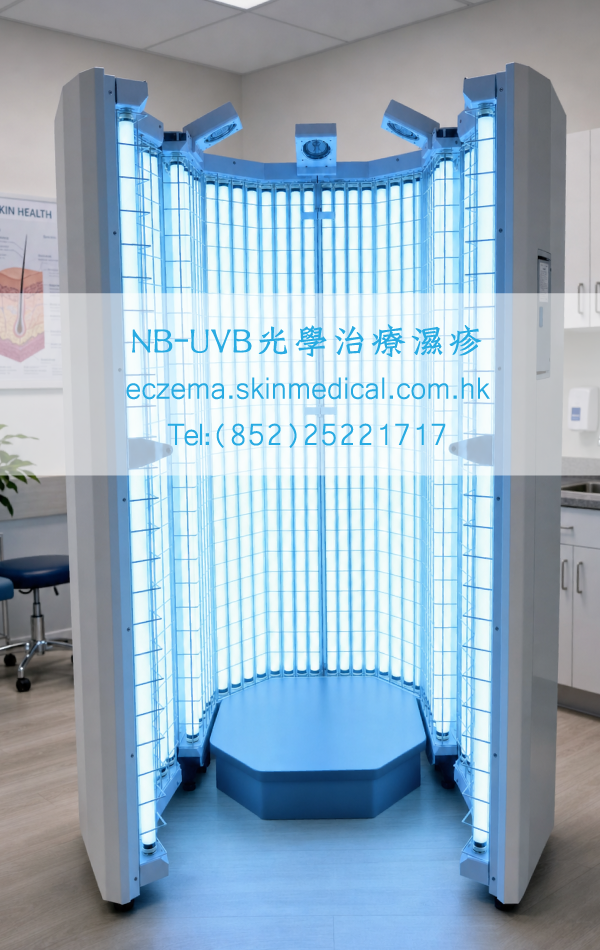
Yes. Narrowband UVB is well established for moderate disease not controlled by topical treatment. It reduces itch and inflammation and allows topical steroid use to be reduced. It usually requires two to three sessions weekly for 8–12 weeks.
Are Beauty Treatments Effective for Eczema?
The pathogenesis and triggers of eczema are not yet fully understood, involving genetic and environmental factors. Even among family members with similar genetics, they do not experience the same environmental exposures, contact with chemicals, skin trauma, emotional events, or environmental stress. Medical assessment and clinical treatment are crucial for managing eczema. Beauty treatments that lack clinical medical recognition and involve misuse or overuse of optical devices, or the use of undocumented remedies, can lead to unpredictable progression or worsening of eczema, and even trigger complications. For medical treatment of eczema, it is advised to seek assistance from a registered doctor.
What are biologics, and would I need one?
Biologics are injections that block a single inflammatory signal. Approved options include dupilumab, tralokinumab, lebrikizumab and nemolizumab. They are for moderate-to-severe disease not controlled by topical treatment and phototherapy, and they do not require routine blood monitoring.
Are JAK inhibitors safe?
Oral JAK inhibitors have shown high efficacy with rapid itch reduction and significant skin clearance in phase 3 trials. They require blood monitoring and carry class warnings relating to infection, blood count and lipid changes, and cardiovascular risk in older patients with risk factors. Suitability depends on age, medical history and disease severity, and should be discussed individually.
Which is better, a biologic or a JAK inhibitor?
Neither is universally better. Abrocitinib and upadacitinib have shown superior efficacy to dupilumab in clinical studies, and act faster — but they require monitoring and carry class warnings that biologics do not. Younger patients wanting rapid control often favour JAK inhibitors; older patients or those with cardiovascular risk factors usually favour a biologic.
Why does my skin go brown after the eczema settles?
This is post-inflammatory hyperpigmentation, which is more prominent in Asian skin. It is not scarring, it fades over months, and it improves by controlling the inflammation rather than by using lightening products.
How to Help Young Children and Adolescents Cope with Eczema?
The appearance of eczema patches and flaking skin not only causes great mental distress to children and adolescents but also leads to peer exclusion/bullying; it equally causes great pain and guilt for parents. Parents are advised to first manage their emotions, understanding that the condition is unavoidable, and seek medical help for their child as early as possible to learn how to soothe eczema and effectively improve it in daily life. Once a treatment plan is established by a doctor, it is recommended that parents and schools communicate as much as possible, instill correct and positive values, maintain an optimistic and proactive attitude, and patiently adhere to medical treatment. At the same time, parents can refer to examples of other people with eczema to encourage and rebuild self-confidence and self-care.
How to Seek the Right Treatment Method?
Eczema should be clinically diagnosed and treated by a registered doctor. Many patients have a family history or involve multiple genetic mutations, and may also share genetic mutations with other autoimmune diseases; doctors will first inquire about the patient's and family's medical history and also establish if the patient has any other autoimmune diseases. Medical Assessment
Step 1: Topical anti-inflammatory treatment
Step 2: Proactive maintenance (most often skipped)
Step 3: NB-UVB Phototherapy
Step 4: Conventional systemic treatment
Step 5: Biologics and oral JAK inhibitors
Reference:
- Davis DMR, Drucker AM, Alikhan A, et al. AAD guidelines of care for the management of atopic dermatitis in adults with topical therapies. J Am Acad Dermatol. 2023.
- Sidbury R, Alikhan A, Bercovitch L, et al. AAD guidelines of care for the management of atopic dermatitis in adults with phototherapy and systemic therapies. J Am Acad Dermatol. 2023.
- Guidelines Development Panel of the Hong Kong College of Paediatricians. Management of Atopic Dermatitis in Children: 2020 Review. HK J Paediatr. 2021;26:42-57. — the key local reference; cite this prominently.
- Wollenberg A, Kinberger M, Arents B, et al. EuroGuiDerm guideline on atopic eczema. J Eur Acad Dermatol Venereol. (most recent update).
- National Institute for Health and Care Excellence. Atopic eczema in under 12s: diagnosis and management. CG57.
- Leung R, Wong G, Lau J, et al. Prevalence of asthma and allergy in Hong Kong schoolchildren: an ISAAC study. Eur Respir J 1997.
- Childhood Wheeze, Allergic Rhinitis, and Eczema in Hong Kong: ISAAC Study from 1995 to 2015. — source of the 21-year local trend data.
- Severity scoring of atopic dermatitis: the SCORAD index. Consensus Report of the European Task Force on Atopic Dermatitis. Dermatology 1993;186:23-31.
- Efficacy and Safety of Lebrikizumab in Combination With Topical Corticosteroids in Adolescents and Adults With Moderate-to-Severe Atopic Dermatitis: A Randomized Clinical Trial (ADhere). JAMA Dermatol.
- ARCADIA 1 and ARCADIA 2 — two identically designed pivotal phase III trials enrolling more than 1,700 patients, evaluating nemolizumab administered subcutaneously every four weeks versus placebo with background topical corticosteroids.
- Sanofi. Press release: decision not to submit amlitelimab in atopic dermatitis for global regulatory reviews. Paris, 24 July 2026.
- Simpson EL, Bieber T, Guttman-Yassky E, et al. Two Phase 3 Trials of Dupilumab versus Placebo in Atopic Dermatitis (SOLO 1 and SOLO 2). N Engl J Med. 2016.
- Chalmers JR, et al. BEEP trial: daily emollient during the first year of life for preventing atopic dermatitis. Lancet. 2020. — the negative prevention trial cited in the article.
- Hong Kong Drug Office, Department of Health — verify local registration status of every systemic agent named.

