
Eczema
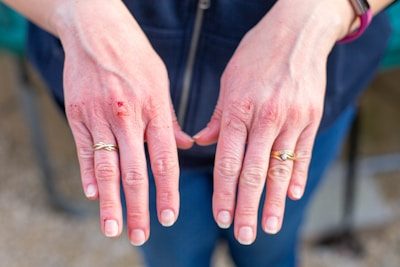
How atopic dermatitis is diagnosed
There is no blood test that diagnoses atopic dermatitis. It is a clinical diagnosis, made on history and examination against established criteria (Hanifin and Rajka; the UK Working Party criteria).
A thorough assessment would typically involve:
- History — age at onset, pattern over time, itch severity, sleep disruption, personal and family history of atopy, occupational and hobby exposures, all previous treatments and how they were actually used.
- Full skin examination, including scalp, hands, feet and flexures.
- Severity scoring — EASI or SCORAD, plus POEM and DLQI for patient-reported impact. Recorded at baseline so change can be measured objectively.
- Photography for comparison over time.
- Assessment for infection where indicated, with swabs.
- Allergy testing — selectively, not routinely. Specific IgE or skin prick testing is appropriate where the history suggests an immediate reaction to a specific food, or where a child has moderate-to-severe eczema not responding to good treatment. Testing without a suggestive history produces false positives that lead to unnecessary food avoidance, which is harmful — it does not improve eczema and can precipitate genuine food allergy.
- Patch testing where allergic contact dermatitis is suspected — particularly in adults with hand eczema, eyelid involvement, or eczema that has changed pattern or stopped responding.
Differential diagnosis
| Condition | Distinguishing features |
| Seborrhoeic dermatitis | Greasy yellowish scale; scalp, eyebrows, nasolabial folds; less itchy |
| Psoriasis | Sharply demarcated, thick silvery scale; extensor surfaces, scalp, nails |
| Scabies | Burrows, finger webs, wrists, genitals; itch worse at night; other household members itching |
| Tinea (fungal) | Ring-shaped with an active scaly edge and central clearing; positive microscopy |
| Contact dermatitis | Corresponds to a contact site; adult onset; patch test positive |
| Cutaneous T-cell lymphoma | Adult onset, persistent fixed patches, unresponsive to treatment; biopsy required |
| Immunodeficiency | Severe infantile eczema with recurrent serious infections and failure to thrive |
The most common mistakes in practice: scabies mistaken for a flare and treated with steroids, tinea treated with steroids, and adult-onset "eczema" that is actually cutaneous lymphoma. Any eczema that is unusual in pattern, adult in onset, or genuinely unresponsive to correct treatment warrants a fresh look.
Reference:
- Davis DMR, Drucker AM, Alikhan A, et al. AAD guidelines of care for the management of atopic dermatitis in adults with topical therapies. J Am Acad Dermatol. 2023.
- Sidbury R, Alikhan A, Bercovitch L, et al. AAD guidelines of care for the management of atopic dermatitis in adults with phototherapy and systemic therapies. J Am Acad Dermatol. 2023.
- Guidelines Development Panel of the Hong Kong College of Paediatricians. Management of Atopic Dermatitis in Children: 2020 Review. HK J Paediatr. 2021;26:42-57. — the key local reference; cite this prominently.
- Wollenberg A, Kinberger M, Arents B, et al. EuroGuiDerm guideline on atopic eczema. J Eur Acad Dermatol Venereol. (most recent update).
- National Institute for Health and Care Excellence. Atopic eczema in under 12s: diagnosis and management. CG57.
- Leung R, Wong G, Lau J, et al. Prevalence of asthma and allergy in Hong Kong schoolchildren: an ISAAC study. Eur Respir J 1997.
- Childhood Wheeze, Allergic Rhinitis, and Eczema in Hong Kong: ISAAC Study from 1995 to 2015. — source of the 21-year local trend data.
- Severity scoring of atopic dermatitis: the SCORAD index. Consensus Report of the European Task Force on Atopic Dermatitis. Dermatology 1993;186:23-31.
- Efficacy and Safety of Lebrikizumab in Combination With Topical Corticosteroids in Adolescents and Adults With Moderate-to-Severe Atopic Dermatitis: A Randomized Clinical Trial (ADhere). JAMA Dermatol.
- ARCADIA 1 and ARCADIA 2 — two identically designed pivotal phase III trials enrolling more than 1,700 patients, evaluating nemolizumab administered subcutaneously every four weeks versus placebo with background topical corticosteroids.
- Sanofi. Press release: decision not to submit amlitelimab in atopic dermatitis for global regulatory reviews. Paris, 24 July 2026.
- Simpson EL, Bieber T, Guttman-Yassky E, et al. Two Phase 3 Trials of Dupilumab versus Placebo in Atopic Dermatitis (SOLO 1 and SOLO 2). N Engl J Med. 2016.
- Chalmers JR, et al. BEEP trial: daily emollient during the first year of life for preventing atopic dermatitis. Lancet. 2020. — the negative prevention trial cited in the article.
- Hong Kong Drug Office, Department of Health — verify local registration status of every systemic agent named.

