
Medical Assessment
Eczema: A Chronic Inflammatory Skin Condition
Eczema affects approximately 20% of children and 3% of adults worldwide. It is a chronic inflammatory skin disease that is extremely itchy, often irresistible to scratch, and characterized by recurrent flare-ups at varying frequencies. The condition presents with both dry and wet states, leading to cycles of dry skin, flaking, weeping, bleeding, or crusting, followed by periods of relief. Over time, the chronic nature of the disease can cause the skin to become lichenified, thickened, and pigmented.
There are several different types of eczema, with Atopic Dermatitis being the most common form. Other types of eczema include Contact Dermatitis, which is triggered by contact with irritants or allergens, and Stasis Dermatitis, which typically affects the lower legs and is associated with circulatory problems.
Causes of Eczema
Currently, there is no known single cause for eczema. In fact, there are many types of eczema, each with at least one contributing factor, if not more. Some of the most common causes include a family history of eczema, exposure to certain environmental triggers, and stress, among others. To learn more about the causes of eczema, click here.
Doctor's Assessment: Diagnosing Eczema The diagnosis of eczema is based on the patient's medical history and clinical/physical examination. The following table summarizes the characteristics to consider when making a diagnosis:
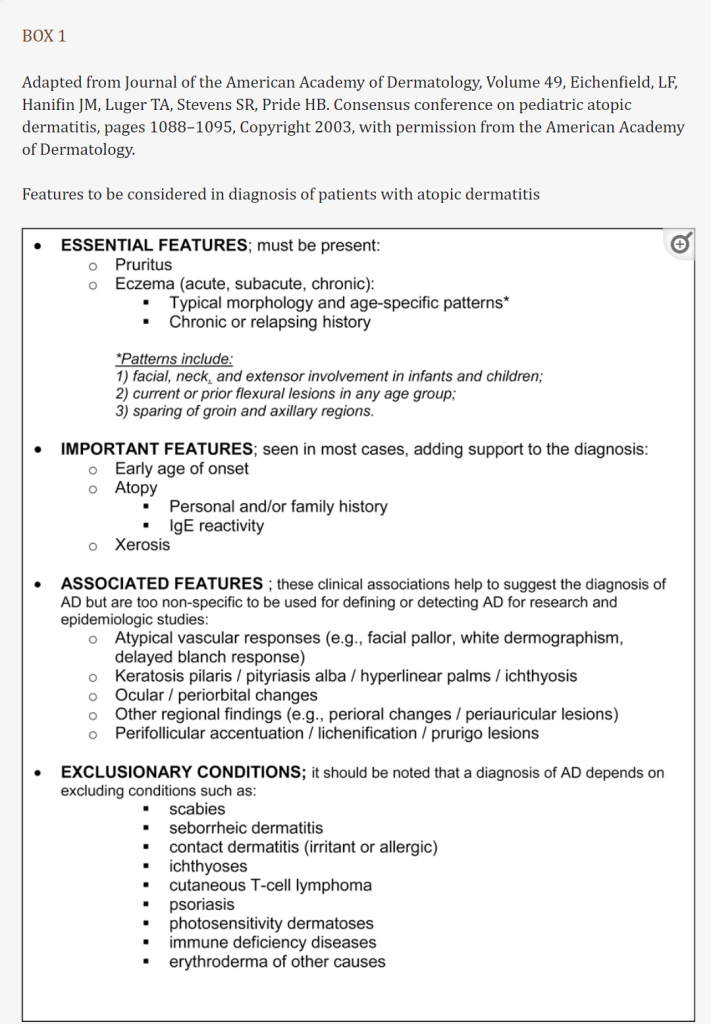
Source: https://www.ncbi.nlm.nih.gov/pmc/articles/PMC4410183/
Basic features of eczema (must be present):
Itching, eczema manifestations (acute, subacute, or chronic), a history of recurrence, and typical distribution patterns, such as the face and neck in infants and children, skin folds, the inner elbows, behind the knees, the groin area, etc.
Important features of eczema (seen in most cases):
Early onset at a young age, a personal and/or family history, elevated IgE levels, and xerosis/dry skin (dryness, scaling, cracking, etc).
Associated features of eczema (may help support the diagnosis, but are not typical and cannot be used to define the diagnosis):
Atypical vascular responses, keratosis pilaris, pityriasis alba, etc.
Exclusion criteria (the following conditions/skin diseases must be ruled out to establish a diagnosis of eczema):
Other inflammatory skin diseases, seborrheic dermatitis, psoriasis, contact allergy, dyshidrosis, ichthyosis, other infections or infestations such as scabies, tinea corporis, pityriasis rosea, or other immunodeficiency or immune system diseases, etc.
Infantile seborrheic dermatitis is often mistaken for eczema. However, it is not itchy and causes cradle cap and moist red areas in the skin folds. Generally speaking, it tends to improve after 6 months of age.
Reference:
Eichenfield, Lawrence F et al. “Guidelines of care for the management of atopic dermatitis: section 1. Diagnosis and assessment of atopic dermatitis.” Journal of the American Academy of Dermatology vol. 70,2 (2014): 338-51. doi:10.1016/j.jaad.2013.10.010
American Academy of Dermatology Association https://www.aad.org/public/diseases/eczema/types/atopic-dermatitis
Guidelines for the diagnosis and assessment of eczema https://dermnetnz.org/topics/guidelines-for-the-diagnosis-and-assessment-of-eczema
National Eczema Association https://nationaleczema.org/eczema/
British Association of Dermatologists https://www.bad.org.uk/pils/atopic-eczema/

