
Evidence-based treatment
The framework is a treatment ladder, and every level continues the one beneath it. Emollients never stop.
| Step | Treatment | Indication |
| Foundation | Emollients, bathing practice, trigger avoidance | Everyone, always |
| Step 1 | Topical corticosteroids; topical calcineurin inhibitors | Mild-to-moderate; flare treatment |
| Step 2 | Proactive maintenance twice weekly; non-steroidal topicals (PDE4 inhibitors, topical JAK, tapinarof) | Recurrent flares at the same sites |
| Step 3 | Narrowband UVB phototherapy | Moderate disease inadequately controlled by topicals; useful steroid-sparing option |
| Step 4 | Conventional systemics: ciclosporin, methotrexate, azathioprine, mycophenolate | Moderate-to-severe |
| Step 5 | Biologics; oral JAK inhibitors | Moderate-to-severe inadequately controlled by the above |

Step 1: Topical anti-inflammatory treatment
Topical corticosteroids remain first-line for flares and have decades of evidence behind them.。
Potency is matched to site and severity: mild for the face and folds, moderate to potent for the body and limbs.
The fingertip unit is the practical measure — the amount squeezed from the fingertip to the first crease treats an area equal to two adult palms.
Applied once or twice daily to inflamed skin until it is smooth and no longer itchy — not merely until the redness fades.
On steroid phobia, plainly. Fear of topical steroids is the most common reason atopic dermatitis remains uncontrolled, and it is particularly prevalent among Chinese patients and parents. The concern is understandable but disproportionate. Skin thinning occurs with prolonged use of potent steroids on delicate sites, not with appropriate, targeted courses. Meanwhile, undertreated eczema causes real harm: sleep loss, infection, thickened skin, and lasting pigmentation. The correct approach is not avoidance but appropriate use — the right potency, on the right site, for long enough, followed by a maintenance plan.
Topical steroid withdrawal, widely discussed online, is a recognised but uncommon phenomenon associated with prolonged high-potency use, especially on the face. It is not a reason to avoid appropriate treatment, and any patient worried about it should discuss it rather than simply stopping.
Topical calcineurin inhibitors (tacrolimus, pimecrolimus) are steroid-free anti-inflammatories, particularly valuable on the face, eyelids, neck and folds, and for long-term maintenance. Pimecrolimus 1% is indicated for mild-to-moderate atopic dermatitis, shows no apparent increase in adverse events compared with topical corticosteroids, and causes less burning than tacrolimus. A transient stinging sensation in the first week is common and settles. The historical black-box warning regarding malignancy has not been supported by long-term data.
Newer non-steroidal topicals. Newer topical options including roflumilast cream, tapinarof cream, and topical JAK inhibitors such as ruxolitinib provide non-steroidal choices for mild-to-moderate disease. Roflumilast cream 0.05%, a topical PDE4 inhibitor, expanded options for very young children with once-daily dosing and good tolerability. Availability in Hong Kong differs from the United States and should be confirmed case by case.
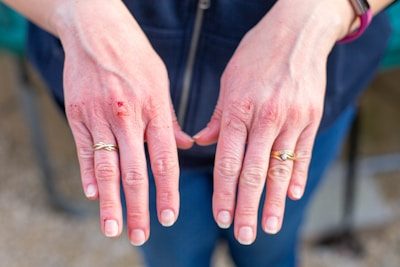
For chronic hand eczema specifically, a topical option now exists: delgocitinib non-selectively inhibits JAK1, JAK2, JAK3 and TYK2, and in phase 3 vehicle-controlled trials showed treatment success rates of up to 37.7% after twice-daily application for 16 weeks. It is the first FDA-approved treatment for moderate-to-severe chronic hand eczema in adults. The cream formulation minimises the systemic risks associated with oral JAK inhibitors.
Reference:
- Davis DMR, Drucker AM, Alikhan A, et al. AAD guidelines of care for the management of atopic dermatitis in adults with topical therapies. J Am Acad Dermatol. 2023.
- Sidbury R, Alikhan A, Bercovitch L, et al. AAD guidelines of care for the management of atopic dermatitis in adults with phototherapy and systemic therapies. J Am Acad Dermatol. 2023.
- Guidelines Development Panel of the Hong Kong College of Paediatricians. Management of Atopic Dermatitis in Children: 2020 Review. HK J Paediatr. 2021;26:42-57. — the key local reference; cite this prominently.
- Wollenberg A, Kinberger M, Arents B, et al. EuroGuiDerm guideline on atopic eczema. J Eur Acad Dermatol Venereol. (most recent update).
- National Institute for Health and Care Excellence. Atopic eczema in under 12s: diagnosis and management. CG57.
- Leung R, Wong G, Lau J, et al. Prevalence of asthma and allergy in Hong Kong schoolchildren: an ISAAC study. Eur Respir J 1997.
- Childhood Wheeze, Allergic Rhinitis, and Eczema in Hong Kong: ISAAC Study from 1995 to 2015. — source of the 21-year local trend data.
- Severity scoring of atopic dermatitis: the SCORAD index. Consensus Report of the European Task Force on Atopic Dermatitis. Dermatology 1993;186:23-31.
- Efficacy and Safety of Lebrikizumab in Combination With Topical Corticosteroids in Adolescents and Adults With Moderate-to-Severe Atopic Dermatitis: A Randomized Clinical Trial (ADhere). JAMA Dermatol.
- ARCADIA 1 and ARCADIA 2 — two identically designed pivotal phase III trials enrolling more than 1,700 patients, evaluating nemolizumab administered subcutaneously every four weeks versus placebo with background topical corticosteroids.
- Sanofi. Press release: decision not to submit amlitelimab in atopic dermatitis for global regulatory reviews. Paris, 24 July 2026.
- Simpson EL, Bieber T, Guttman-Yassky E, et al. Two Phase 3 Trials of Dupilumab versus Placebo in Atopic Dermatitis (SOLO 1 and SOLO 2). N Engl J Med. 2016.
- Chalmers JR, et al. BEEP trial: daily emollient during the first year of life for preventing atopic dermatitis. Lancet. 2020. — the negative prevention trial cited in the article.
- Hong Kong Drug Office, Department of Health — verify local registration status of every systemic agent named.

