
Cause and types
What causes atopic dermatitis?
There is no single cause. The condition arises where genetic susceptibility meets environment.
• Genetics. A family history of eczema, asthma or allergic rhinitis is the strongest single predictor. Risk factors include a family history of eczema, asthma and allergic rhinitis, along with increased exposure to allergens such as those in soaps, bleaches and dyes, or occupational wet work.
• Barrier gene variants, filaggrin being the best characterised.
• Immune dysregulation — the type 2 inflammatory response described above.
• Skin microbiome disturbance. Staphylococcus aureus colonises the majority of eczematous skin and worsens inflammation, even without frank infection.
• Environment. Low humidity, air conditioning, heat and sweat, hard water, soaps and detergents, wool and rough fabrics, dust mite exposure, and air pollution.
• Stress and sleep deprivation, which are both consequence and trigger.
Common triggers to identify individually: heat and sweating (a major factor in the Hong Kong climate), soaps and bubble baths, fragrance, wool, dust mite, pet dander, low-humidity air-conditioned environments, upper respiratory infections, and emotional stress. Triggers differ between individuals — which is why a trigger diary is more useful than a generic avoidance list.
Types and patterns
Atopic dermatitis is one condition with several recognisable presentations. Classification is by age pattern, morphology and severity rather than by discrete "types."
By age
| Age group/span> | Typical distribution | Typical appearance |
| Infantile (0–2 years) | Cheeks, forehead, scalp, outer limbs, trunk. Nappy area usually spared. | Red, weeping, crusted patches. Very itchy; infants rub against bedding. |
| Childhood (2–12 years) | Flexures — elbow creases, behind the knees, wrists, ankles, neck. | Drier, thicker, more scaly. Lichenification begins. |
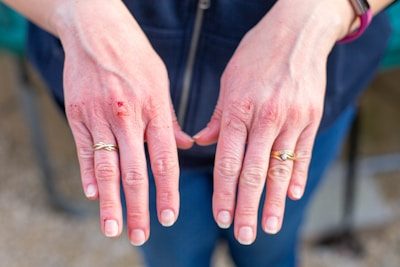
| Adolescent / adult | Flexures, hands, eyelids, face and neck, upper trunk. | Thickened, leathery, lichenified. Hand eczema often dominates. |
| Elderly-onset | Often more widespread, less flexural | Marked dryness, sometimes nummular pattern |
By morphology
Nummular (discoid) - coin-shaped, well-defined plaques, often on the limbs. Frequently mistaken for fungal infection.
Follicular - small itchy bumps centred on hair follicles. This pattern is more common in Chinese and other Asian patients and is often missed, because it does not look like textbook eczema.
Prurigo-type - firm, intensely itchy nodules from chronic scratching.
Hand and foot eczema - may be the only site in adults, and is strongly aggravated by occupational wet work.
Head-and-neck predominant - in adults, this pattern raises the question of Malassezia sensitivity.
A point specific to Asian skin. Atopic dermatitis in Chinese and other East Asian patients more often shows well-demarcated, thickened, scaly plaques that can look psoriasis-like, alongside a greater tendency to follicular accentuation. There is also a much higher risk of post-inflammatory hyperpigmentation — the brown marks left after a patch settles. These marks are not scars, they fade over months, and they respond to controlling the inflammation rather than to lightening creams. Patients are frequently more distressed by the pigmentation than by the eczema itself, and this deserves to be addressed directly rather than dismissed.
By severity
Severity is graded using validated tools — SCORAD, EASI, and the patient-reported POEM and DLQI. These matter because they convert "it's quite bad" into a number that can be tracked, and because access to advanced therapy usually requires documented severity.
| Severity | Rough description |
| Mild | Dry skin, infrequent itch, small areas |
| Moderate | Frequent itch, visible redness, disturbed sleep, larger areas |
| Severe | Widespread, continuous itch, significantly disturbed sleep, marked impact on daily life |
Reference:
- Davis DMR, Drucker AM, Alikhan A, et al. AAD guidelines of care for the management of atopic dermatitis in adults with topical therapies. J Am Acad Dermatol. 2023.
- Sidbury R, Alikhan A, Bercovitch L, et al. AAD guidelines of care for the management of atopic dermatitis in adults with phototherapy and systemic therapies. J Am Acad Dermatol. 2023.
- Guidelines Development Panel of the Hong Kong College of Paediatricians. Management of Atopic Dermatitis in Children: 2020 Review. HK J Paediatr. 2021;26:42-57. — the key local reference; cite this prominently.
- Wollenberg A, Kinberger M, Arents B, et al. EuroGuiDerm guideline on atopic eczema. J Eur Acad Dermatol Venereol. (most recent update).
- National Institute for Health and Care Excellence. Atopic eczema in under 12s: diagnosis and management. CG57.
- Leung R, Wong G, Lau J, et al. Prevalence of asthma and allergy in Hong Kong schoolchildren: an ISAAC study. Eur Respir J 1997.
- Childhood Wheeze, Allergic Rhinitis, and Eczema in Hong Kong: ISAAC Study from 1995 to 2015. — source of the 21-year local trend data.
- Severity scoring of atopic dermatitis: the SCORAD index. Consensus Report of the European Task Force on Atopic Dermatitis. Dermatology 1993;186:23-31.
- Efficacy and Safety of Lebrikizumab in Combination With Topical Corticosteroids in Adolescents and Adults With Moderate-to-Severe Atopic Dermatitis: A Randomized Clinical Trial (ADhere). JAMA Dermatol.
- ARCADIA 1 and ARCADIA 2 — two identically designed pivotal phase III trials enrolling more than 1,700 patients, evaluating nemolizumab administered subcutaneously every four weeks versus placebo with background topical corticosteroids.
- Sanofi. Press release: decision not to submit amlitelimab in atopic dermatitis for global regulatory reviews. Paris, 24 July 2026.
- Simpson EL, Bieber T, Guttman-Yassky E, et al. Two Phase 3 Trials of Dupilumab versus Placebo in Atopic Dermatitis (SOLO 1 and SOLO 2). N Engl J Med. 2016.
- Chalmers JR, et al. BEEP trial: daily emollient during the first year of life for preventing atopic dermatitis. Lancet. 2020. — the negative prevention trial cited in the article.
- Hong Kong Drug Office, Department of Health — verify local registration status of every systemic agent named.

