Evidence-based treatment
The framework is a treatment ladder, and every level continues the one beneath it. Emollients never stop.
| Step | Treatment | Indication |
| Foundation | Emollients, bathing practice, trigger avoidance | Everyone, always |
| Step 1 | Topical corticosteroids; topical calcineurin inhibitors | Mild-to-moderate; flare treatment |
| Step 2 | Proactive maintenance twice weekly; non-steroidal topicals (PDE4 inhibitors, topical JAK, tapinarof) | Recurrent flares at the same sites |
| Step 3 | Narrowband UVB phototherapy | Moderate disease inadequately controlled by topicals; useful steroid-sparing option |
| Step 4 | Conventional systemics: ciclosporin, methotrexate, azathioprine, mycophenolate | Moderate-to-severe |
| Step 5 | Biologics; oral JAK inhibitors | Moderate-to-severe inadequately controlled by the above |

Step 3: NB-UVB Phototherapy
Narrowband UVB phototherapy (311 - 312 nm) is a well-established treatment for moderate atopic dermatitis not adequately controlled by topical therapy, and it occupies a genuinely useful position on the ladder: more effective than topicals alone, without the systemic exposure of tablets or injections.
- Typically two to three sessions weekly, with the dose increased gradually.
- Most patients notice improvement within 4–8 weeks; a course usually runs 8–12 weeks.
- It reduces itch, reduces S. aureus colonisation, and allows topical steroid use to be cut back substantially.
- Suitable for adults and, in many cases, older children who can stand still in the cabinet.
It is particularly worth considering for patients who want to avoid or defer systemic medication, patients who have plateaued on topical treatment, and those whose disease is widespread but not severe enough to justify a biologic. Cumulative UV exposure is tracked, eyes are protected, and the main short-term effects are redness and dryness.
The practical constraint is attendance: two to three visits per week for two to three months. For patients working in Central this is often more feasible than it sounds, but it should be planned honestly at the outset — a course started and abandoned at week three achieves nothing. Phototherapy is available in this clinic.
Treatment Process
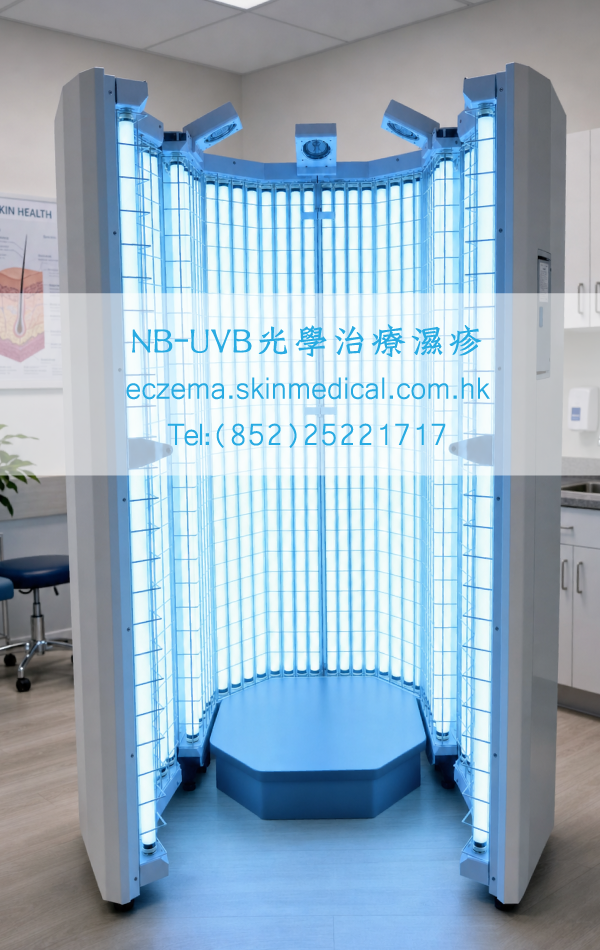
In a typical NB-UVB treatment session, the patient stands inside a specially designed cabinet equipped with fluorescent lamps that emit NB-UVB light. Each session lasts only a few minutes, and treatments are generally administered 1 to 2 times per week. The duration of the treatment varies but usually continues until there is a noticeable improvement in the skin.
NB-UVB phototherapy is one of the standard treatment methods for eczema (atopic dermatitis). Clinically, it effectively reduces skin inflammation and alleviates itching. This treatment offers a high level of safety and is suitable for infants, adolescents, pregnant women, and individuals of any age under medical supervision.
NB-UVB phototherapy specifically refers to the use of light within the UVB spectrum at wavelengths between 311-312 nm. This range is the most beneficial part of natural sunlight for skin conditions and minimizes exposure to other harmful carcinogenic wavelengths.
Under a doctor’s diagnosis and established treatment plan, NB-UVB light penetrates the skin and affects the immune cells (T-cells) that contribute to the inflammation associated with eczema. It decreases both the number and activity of these T-cells, leading to reduced inflammation and effective relief from the symptoms of eczema (atopic dermatitis).
Reference:
- Davis DMR, Drucker AM, Alikhan A, et al. AAD guidelines of care for the management of atopic dermatitis in adults with topical therapies. J Am Acad Dermatol. 2023.
- Sidbury R, Alikhan A, Bercovitch L, et al. AAD guidelines of care for the management of atopic dermatitis in adults with phototherapy and systemic therapies. J Am Acad Dermatol. 2023.
- Guidelines Development Panel of the Hong Kong College of Paediatricians. Management of Atopic Dermatitis in Children: 2020 Review. HK J Paediatr. 2021;26:42-57. — the key local reference; cite this prominently.
- Wollenberg A, Kinberger M, Arents B, et al. EuroGuiDerm guideline on atopic eczema. J Eur Acad Dermatol Venereol. (most recent update).
- National Institute for Health and Care Excellence. Atopic eczema in under 12s: diagnosis and management. CG57.
- Leung R, Wong G, Lau J, et al. Prevalence of asthma and allergy in Hong Kong schoolchildren: an ISAAC study. Eur Respir J 1997.
- Childhood Wheeze, Allergic Rhinitis, and Eczema in Hong Kong: ISAAC Study from 1995 to 2015. — source of the 21-year local trend data.
- Severity scoring of atopic dermatitis: the SCORAD index. Consensus Report of the European Task Force on Atopic Dermatitis. Dermatology 1993;186:23-31.
- Efficacy and Safety of Lebrikizumab in Combination With Topical Corticosteroids in Adolescents and Adults With Moderate-to-Severe Atopic Dermatitis: A Randomized Clinical Trial (ADhere). JAMA Dermatol.
- ARCADIA 1 and ARCADIA 2 — two identically designed pivotal phase III trials enrolling more than 1,700 patients, evaluating nemolizumab administered subcutaneously every four weeks versus placebo with background topical corticosteroids.
- Sanofi. Press release: decision not to submit amlitelimab in atopic dermatitis for global regulatory reviews. Paris, 24 July 2026.
- Simpson EL, Bieber T, Guttman-Yassky E, et al. Two Phase 3 Trials of Dupilumab versus Placebo in Atopic Dermatitis (SOLO 1 and SOLO 2). N Engl J Med. 2016.
- Chalmers JR, et al. BEEP trial: daily emollient during the first year of life for preventing atopic dermatitis. Lancet. 2020. — the negative prevention trial cited in the article.
- Hong Kong Drug Office, Department of Health — verify local registration status of every systemic agent named.

