
Eczema
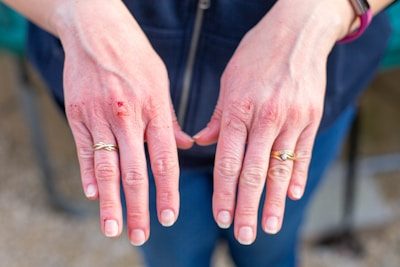
Atopic dermatitis: Clinical features
The core features are itch (essential to the diagnosis — eczema without itch is not eczema), dryness, and an age-typical distribution with a chronic relapsing course.
Supporting features frequently seen: extra folds under the lower eyelids (Dennie-Morgan lines), darkening around the eyes, pallor around the mouth, accentuated palm creases, keratosis pilaris ("chicken skin" on the upper arms), white dermographism, and nipple eczema.
The itch deserves separate attention. It is typically worse in the evening and at night, it disrupts sleep in both the patient and often the parents, and it drives an itch-scratch cycle that is self-sustaining. Interleukin-31 is a key mediator driving pruritus, barrier dysfunction, type 2 inflammation and fibrosis. Night-time scratching that a patient is unaware of is one of the main reasons eczema fails to settle, and it is one of the most useful things to ask about at a consultation.
Complications to recognise
Bacterial infection. Weeping, honey-coloured crusting, pustules, sudden worsening, pain. Usually S. aureus.
Eczema herpeticum. ⚠️ This is an emergency. Widespread clusters of small, uniform, punched-out erosions, often with fever and feeling unwell, spreading rapidly over 24–48 hours. It requires same-day assessment and antiviral treatment. If this is developing, do not wait for a routine appointment — attend an emergency department.
Molluscum contagiosum and viral warts, more extensive in eczematous skin.
Sleep disturbance, with knock-on effects on growth in children, and on concentration and mood at any age.
Psychological impact. Anxiety and depression rates are elevated. In adolescents, visible facial and hand involvement is particularly damaging.
Associated conditions - the atopic march
Atopic dermatitis is often the first step in a sequence: eczema in infancy, then food allergy, then asthma, then allergic rhinitis. Roughly a third of children with atopic dermatitis go on to develop asthma, and a similar or larger proportion develop allergic rhinitis. Early treatment of atopic dermatitis is considered necessary to prevent the atopic march leading to comorbidities such as asthma and allergic rhinitis.
Whether treating eczema well actually prevents the later conditions remains unproven — the evidence is suggestive rather than conclusive, and I would not want to overstate it. What is certain is that controlling the eczema itself is worthwhile on its own terms.
Reference:
- Davis DMR, Drucker AM, Alikhan A, et al. AAD guidelines of care for the management of atopic dermatitis in adults with topical therapies. J Am Acad Dermatol. 2023.
- Sidbury R, Alikhan A, Bercovitch L, et al. AAD guidelines of care for the management of atopic dermatitis in adults with phototherapy and systemic therapies. J Am Acad Dermatol. 2023.
- Guidelines Development Panel of the Hong Kong College of Paediatricians. Management of Atopic Dermatitis in Children: 2020 Review. HK J Paediatr. 2021;26:42-57. — the key local reference; cite this prominently.
- Wollenberg A, Kinberger M, Arents B, et al. EuroGuiDerm guideline on atopic eczema. J Eur Acad Dermatol Venereol. (most recent update).
- National Institute for Health and Care Excellence. Atopic eczema in under 12s: diagnosis and management. CG57.
- Leung R, Wong G, Lau J, et al. Prevalence of asthma and allergy in Hong Kong schoolchildren: an ISAAC study. Eur Respir J 1997.
- Childhood Wheeze, Allergic Rhinitis, and Eczema in Hong Kong: ISAAC Study from 1995 to 2015. — source of the 21-year local trend data.
- Severity scoring of atopic dermatitis: the SCORAD index. Consensus Report of the European Task Force on Atopic Dermatitis. Dermatology 1993;186:23-31.
- Efficacy and Safety of Lebrikizumab in Combination With Topical Corticosteroids in Adolescents and Adults With Moderate-to-Severe Atopic Dermatitis: A Randomized Clinical Trial (ADhere). JAMA Dermatol.
- ARCADIA 1 and ARCADIA 2 — two identically designed pivotal phase III trials enrolling more than 1,700 patients, evaluating nemolizumab administered subcutaneously every four weeks versus placebo with background topical corticosteroids.
- Sanofi. Press release: decision not to submit amlitelimab in atopic dermatitis for global regulatory reviews. Paris, 24 July 2026.
- Simpson EL, Bieber T, Guttman-Yassky E, et al. Two Phase 3 Trials of Dupilumab versus Placebo in Atopic Dermatitis (SOLO 1 and SOLO 2). N Engl J Med. 2016.
- Chalmers JR, et al. BEEP trial: daily emollient during the first year of life for preventing atopic dermatitis. Lancet. 2020. — the negative prevention trial cited in the article.
- Hong Kong Drug Office, Department of Health — verify local registration status of every systemic agent named.

